Showing posts with label Language. Show all posts

Friday, February 27, 2009

Pay respect to your elders

Reading University researchers claim "I", "we", "two" and "three" are among the most ancient, dating back tens of thousands of years.

Their computer model analyses the rate of change of words in English and the languages that share a common heritage.

The team says it can predict which words are likely to become extinct - citing "squeeze", "guts", "stick" and "bad" as probable first casualties.
Somehow I doubt that last one will happen...

Friday, January 09, 2009

Finally, someone said it

What's behind this disparity? Word processors and search engines have different goals. The latter has to field queries as broad and varied as the Internet itself, so it needs a very large vocabulary in order to differentiate spelling mistakes from legitimate search terms. Word processors are much more conservative, limiting their lexicon to words that are definitely legitimate. This way, a program like Word can catch virtually every typo, even if it means misidentifying some proper names and newer words. In other words, search engines put breadth first and spelling accuracy second while word processors are the other way around. If you type in Monkees, Google will assume you're searching for the band; Word will give you a red squiggly line, thinking you've screwed up the word monkeys.

Not surprisingly, search engines and word processors build their dictionaries differently. A search engine's lexicon is typically put together using words gathered from Web pages or old search queries—a huge corpus of real-world data that constitutes a list of valid words and their frequency in the language. Word-processing lexicons are more heavily chaperoned, and the pace at which new terms enter the dictionary is much slower.

Tuesday, November 11, 2008

Some are useful, most are just old

With about a billion more in the ensuing comments. I've used way too many of these, much too recently...
Mr Butterfield said: "We grow tired of anything that is repeated too often – an anecdote, a joke, a mannerism – and the same seems to happen with some language."

The top ten most irritating phrases:

1 - At the end of the day

2 - Fairly unique

3 - I personally

4 - At this moment in time

5 - With all due respect

6 - Absolutely

7 - It's a nightmare

8 - Shouldn't of

9 - 24/7

10 - It's not rocket science

Friday, October 17, 2008

Dances with consonants

Ms. Howling Buffalo, 25, said she, too, had been inspired to take Arapaho classes because her grandmother no longer has anyone to speak with and fears she is losing her first language.

Such sentiments are not uncommon on the reservation and have become more pronounced in the five years since Helen Cedar Tree, at 96 the oldest living Northern Arapaho, made an impassioned plea to the tribe’s council of elders.

“She said: ‘Look at all of you guys talking English, and you know your own language. It’s like the white man has conquered us,’ ” said Gerald Redman Sr., the chairman of the council of elders. “It was a wake-up call.”

A group of Arapaho families had sent their children to a pre-kindergarten language program for years, but it was not enough. Heeding Ms. Cedar Tree’s words, the tribe began using Arapaho dictionaries, night classes, CDs made by the tribe, and anything they could find to help resuscitate the language. In the end, “we knew in our hearts that immersion was the only way we were going to turn this around,” said Mr. Wilson, a member of the Oglala Lakota tribe.

Friday, April 04, 2008

Ellipses are next

Tongue tucked stealthily in cheek, Jon Henley reports on an only-in-Europe fracas over the semicolon, the demise of which some parties are trying to hasten along.
Encouragingly, a Committee for the Defence of the Semicolon appeared on the web (only to disappear some days later, which cannot be a very good sign). Articles have been written in newspapers and magazines. The topic is being earnestly discussed on the radio. It was even the subject of an April Fool's joke on a leading internet news site, which claimed, perfectly plausibly, that President Nicolas Sarkozy had just decreed that to preserve the poor point-virgule from an untimely end, it must henceforth be used at least three times a page in all official correspondence.

In the red corner, desiring nothing less than the consignment of the semicolon to the dustbin of grammatical history, are a pair of treacherous French writers and (of course) those perfidious Anglo-Saxons, for whose short, punchy, uncomplicated sentences, it is widely rumoured, the rare subtlety and infinite elegance of a good semicolon are surplus to requirements. The point-virgule, says legendary writer, cartoonist and satirist François Cavanna, is merely "a parasite, a timid, fainthearted, insipid thing, denoting merely uncertainty, a lack of audacity, a fuzziness of thought".

Thursday, November 01, 2007

They can spell, but they can't count

  • The Seattle Post-Intelligencer reports on Webster's new "Word of the Year."
And it's two words: "Grass station."
It's a play on "gas station" and refers to a theoretical fill-up spot featuring ethanol and biomass fuels, some of which are distilled from actual grass. Grass station beat out such entries as freegan, aka Dumpster diver, and iPodization. This doesn't mean grass station will show up in Webster's anytime soon. As one editor said: "It's merely one that made us chuckle, think, reflect, or just shake our heads." Last year's winner: crackberry.
Last year's word, by a hair...

Thursday, October 18, 2007

Literary link-o-rama

  • The New Yorker profiles the creators of HBO's top-notch show The Wire.
Finely tuned as Simon’s ear is for the newsroom, it is perhaps even better calibrated for the street corner and the precinct, having been sharpened by thirteen years of daily crime reporting. Viewers of “The Wire” must master a whole argot, though it can take a while, because the words are never defined, just as they wouldn’t be by real people tossing them around. To have “suction” is to have pull with your higher-ups on the police force or in City Hall; a “redball” is a high-profile case with political consequences; to “re-up” is to get more drugs to sell. Drugs are branded with names taken from the latest news cycle: Pandemic, W.M.D., Greenhouse Gas. “The game” is the drug trade, although it emerges during the course of the show as a metaphor for the web of constraints that political and economic institutions impose on the people trapped within them. And, in one memorable neologism, a penis is referred to as a “Charles Dickens.”

Because Simon and his primary writing partner, Ed Burns—a former Baltimore homicide detective who was once one of Simon’s sources—are both middle-aged white men, people tend to assume that the dialogue spoken by the drug dealers and ghetto kids is ad-libbed by the black actors on the show. In fact, one of the show’s writers was always present on the set, keeping the actors on script. A single dropped word was noted and corrected. Gbenga Akinnagbe, the actor who plays a drug dealer’s henchman named Chris Partlow, said, “This is David’s domain. He gets the streets of Baltimore better than we do.” The novelist Dennis Lehane (“Mystic River”), whom Simon hired to write several scripts, agrees: “When you hear the really authentic street poetry in the dialogue, that’s David, or Ed Burns. Anything that’s literally 2006 or 2007 African-American ghetto dialogue—that’s them. They are so much further ahead of the curve on that.”
  • The original versions of Raymond Carver's short stories may be published in the near future.
Carver, who died in 1988 at 50, had tried to set the record straight himself. He restored and republished five of the stories from “What We Talk About” in magazines or later collections. In “Where I’m Calling From,” a volume of new and selected stories that Mr. Fisketjon helped edit and that was published the year Carver died, three of the stories that had appeared in “What We Talk About” — “So Much Water So Close to Home,” “The Bath” (retitled “A Small, Good Thing”) and “Distance” — appeared in restored form. But Carver also included four other stories from “What We Talk About” in the versions edited by Mr. Lish.

“When we put together ‘Where I’m Calling From,’ these were the stories that he handpicked from his work to live in posterity in the versions that he wanted them to live in,” Mr. Fisketjon said. “If that is not the end of the story, I don’t know what that would be.”
The FCC's decision raises another mystery about swearing: the bizarre number of different ways in which we swear. There is cathartic swearing, as when we slice our thumb along with the bagel. There are imprecations, as when we offer advice to someone who has cut us off in traffic. There are vulgar terms for everyday things and activities, as when Bess Truman was asked to get the president to say fertilizer instead of manure and she replied, "You have no idea how long it took me to get him to say manure." There are figures of speech that put obscene words to other uses, such as the barnyard epithet for insincerity, the army acronym snafu, and the gynecological-flagellative term for uxorial dominance. And then there are the adjective-like expletives that salt the speech and split the words of soldiers, teenagers, and Irish rock-stars.

But perhaps the greatest mystery is why politicians, editors, and much of the public care so much.
Researchers scoured grammatical texts dating back to the days of Old English, cataloguing all the irregular verbs they came across. Among them: the still irregular "sing" / "sang," "go" / "went" as well as the since-regularized "smite" which once was "smote" in Old English but since has become "smited," and "slink," which is now "slinked" but 1,200 years ago was "slunk." They located 177 verbs that were irregular in Old English and 145 that were still irregular in Middle English; today, only 98 of the 177 verbs have not been "regularized.'"

After calculating the frequency of use of each of the 177 irregular Old English verbs, researchers determined that the words that evolved most quickly into regular conjugational forms were used significantly less than those that went unchanged over time. In fact, their statistical analysis determined that given two verbs, if one was used 100 times less frequently than the other, it would evolve 10 times faster than the verb employed more often. They predict the next verb to fall into line will be wed, the past tense of which will regularize from wed to wedded.

By being more frequent, a verb is more stable," says study co-author Erez Lieberman, a graduate student in applied mathematics at Harvard University. He adds that both the Harvard and Reading papers lay out a case for a version of natural selection that acts on linguistic evolution and mirrors biological evolution. "Both studies," he says, "illustrate this profound effect that frequency has in the survival of a word."

Wednesday, October 10, 2007

More fun with language

Thanks, Senator Craig, for contributing to our culture so.
The online Urban Dictionary defines "wide stance" as a euphemism for a closeted homosexual. David Kurtz of the blog "Talking Points Memo" called Craig's wide stance claim "The Best Legal Defense of 2007." And Beau Jarvis, who writes about wine, travel and food on the blog "Basic Juice," notes that the phrase has become less than innocent and proposes "cleansing" it by using it to describe a well-balanced wine.

...Will "wide stance" last as long in popular usage?

"You search the blogosphere or even newspapers and you'll find a lot of references to it," said Grant Barrett, co-host of the nationwide public radio show "A Way With Words" and author of several slang dictionaries. "People are toying with the words, seeing how it feels on the keyboard."

Craig's office declined to comment.

Tuesday, October 09, 2007

Spooky language alert

Let's see, how many bridges have collapsed this year? Hmm? And the solution is, "Stop saying those words!" Ehhh... what?
ST. PAUL, Minn. - State highway officials around the country want the government to stop scaring the public by using dire-sounding phrases such as "structurally deficient" and "fracture critical" to describe bridges in need of repairs.

In interviews and government documents obtained by The Associated Press, some engineers say the terms are making America's bridges sound shakier than they really are, and they would prefer less-alarming phrases, or perhaps a "Health Index" for the nation's spans.

The issue came up after the Minneapolis bridge collapse Aug. 1 that killed 13 people. The span, along with more than 73,000 other U.S. bridges, had been classified as structurally deficient, a term some engineers say sent shudders across the nation because it was widely misunderstood.

"People seem to think a bridge is within a hair's breadth of collapse when they hear these terms," Montana's chief transportation engineer Loran Frazier vented in an e-mail survey of his peers after the Interstate 35W disaster. "There seemed to be borderline hysteria regarding the bridges."

Tuesday, July 31, 2007

A language reborn

  • The "lost language" Pitmatic gets its first dictionary.
Cool.
First recorded in Victorian newspapers, the language was part of the intense camaraderie of underground working which excluded even friendly outsiders such as the parliamentary commissioners pressing for better conditions in the pits in 1842.

"The barriers to our intercourse were formidable," they wrote in their report on encountering the Pitmatic dialect. "Numerous mining technicalities, northern provincialisms, peculiar intonation and accents and rapid and indistinct utterance rendered it essential for us to devote time to the study of these peculiarities ere we could translate and write the evidence."

Friday, June 08, 2007

Naughty, naughty

Since then, fuck has remained consistently offensive, though it has lost some of its original punch. The word only developed its nonsexual meanings in the late 19th century. (You can find that usage in Civil War court-martial records, for instance.) The word became much more widely used after World War I and now, along with shit, accounts for half the swearing that goes on in public. At this point, even our president and vice president will use it casually in its nonsexual sense. In March 2002, Bush interrupted a meeting Condoleezza Rice was holding and yelled, ""Fuck Saddam. We're taking him out!" And Dick Cheney famously said "Go fuck yourself" to Patrick Leahy on the floor of the Senate.

Most often, swear words grow less vulgar with time. Back in Shakespeare's day, when one's lineage mattered a lot more, the word bastard was so offensive it was often written "b-d." Contemporary readers might not recognize the power of a line like this one, spoken by Capt. MacMorris in Act III of Henry V: "What about my nation? Is my nation a villain, and a bastard, and a knave, and a rascal?" Meanwhile, shit was once a standard Old English word for feces. Today, it remains one of the most versatile vulgarities in our language. These days, you can be "shit-scared" (so scared you shit yourself), live in a "shit hole," or have "shit for brains" (be dumb). And, of course, the shit can also hit the fan. President Bush used another version when he told British Prime Minister Tony Blair that the United Nations needed to "get Syria to get Hezbollah to stop doing this shit."
I don't necessarily think that because a President says something, it's suddenly okay -- especially when we consider the President we're talking about here. But anyways.

Monday, July 17, 2006

For love or money

A wonderful essay. "Benton" (a pseudonym) talks about what drove his desire to work with language and the humanities, coming up with a lot of details and thoughts that are awfully familar:
There was a strong material component to English; it wasn't just about words or ideas. I associated literature with the feelings of fall — the vague sadness of the end of summer, the crisp air, sweaters and wood smoke, stained glass and Gothic architecture, and the optimism that comes with new books and stationery. All of those associations took place in an institutional setting apart from teachers, though teachers were necessary because they made demands and offered their experience.

...In a course I taught last spring, after three months of tracing the development of literary theory from humanism to structuralism to poststructuralism to the dilemmas of the present, I finally asked my students the question: "So, why do you want to study literature, knowing what you now know?" I wondered if studying a century of cynicism had altered their motives in the slightest.

They were all considering graduate school, but their answers had little to do with what I knew they would need to write in their application essays. Sitting in a circle in the grass, backed by purple hydrangeas, they offered the following motives:
  • Formative experiences with reading as a child: being read to by beloved parents and siblings, discovering the world of books and solitude at a young age.
  • Feelings of alienation from one's peers in adolescence, turning to books as a form of escapism and as a search for a sympathetic connection to other people in other places and times.
  • A love for books themselves, and libraries, as sites of memory and comfort.
  • A "geeky" attraction to intricate alternate worlds such as those created by Tolkien, C.S. Lewis, and George Lucas.
  • Contact with inspirational teachers who recognized and affirmed one's special gifts in reading and writing, often combined with negative experiences in other subjects like math and chemistry.
  • A transference of spiritual longings — perhaps cultivated in a strict religious upbringing — toward more secular literary forms that inspired "transcendence."
  • A fascination with history or science that is not grounded in a desire for rigorous data collection or strict interpretive methodologies.
  • A desire for freedom and independence from authority figures; a love for the free play of ideas. English includes everything, and all approaches are welcome, they believe.
  • A recognition of mortality combined with a desire to live fully, to have multiple lives through the mediation of literary works.
  • A desire to express oneself through language and, in so doing, to make a bid for immortality.
  • A love for the beauty of words and ideas, often expressed in a desire to read out loud and perform the text.
  • An attraction to the cultural aura of being a creative artist, sometimes linked to aristocratic and bohemian notions of the good life.
  • A desire for wisdom, an understanding of the big picture rather than the details that obsess specialists.
To all this, check, check, check. Couldn't have said it better myself. I've been tempted to pursue a career in academia, to go off to grad school and take this idea all the way, but something has always held me back, perhaps because, like the professor says, I fear that I would lose my love of it all, and forget why I'd tried to pursue it in the first place.

Thursday, May 11, 2006

Funny words

A friend forwarded me an amusing email:

MENSA INVITATIONAL

The Washington Post's Mensa Invitational once again asked readers to take any word from the dictionary, alter it by adding, subtracting, or changing one letter, and supply a new definition.

Here are this year's winners. Read them carefully. Each is a real word with only one letter altered to form an artificial word. They are terrifically innovative:

1. Intaxication: Euphoria at getting a tax refund, which lasts until you realize it was your money to start with
2. Reintarnation: Coming back to life as a hillbilly.
3. Bozone (n.): The substance surrounding stupid people that stops bright ideas from penetrating.
4. Foreploy: Any misrepresentation about yourself for the purpose of getting laid.
5. Cashtration (n.): The act of buying a house, which renders the subject financially impotent for an indefinite period.
6. Giraffiti: Vandalism spray-painted very, very high.
7. Sarchasm: The gulf between the author of sarcastic wit and the person who doesn't get it.
8. Inoculatte: To take coffee intravenously when you are running late.
9. Hipatitis: Terminal coolness
10. Osteopornosis: A degenerate disease. (This one got extra credit.)
11. Karmageddon: It's like, when everybody is sending off all these really bad vibes, right? And then, like, the Earth explodes and it's like, a serious bummer.
12. Decafalon (n.): The grueling event of getting through the day consuming only things that are good for you.
13. Glibido: All talk and no action.
14. Dopeler effect: The tendency of stupid ideas to seem smarter when they come at you rapidly.
15. Arachnoleptic fit (n.): The frantic dance performed just after you've accidentally walked through a spider web.
16. Beelzebug (n.): Satan in the form of a mosquito, that gets into your bedroom at three in the morning and cannot be cast out.
17. Caterpallor (n.): The color you turn after finding half a worm in the fruit you're eating.
18. Ignoranus: A person who's both stupid and an asshole.
Alas, this isn't quite what it appears to be; the Washington Post has no such "Mensa Invitational." This is an oft-circulated Internet joke chain letter, as detailed here.

Still... pretty funny stuff.

Friday, April 21, 2006

Choosing the right words

Researchers at the California Institute of Technology in Pasadena have hit on something intriguing:
Remarkably, the study has concluded that the letters we use can be viewed as a mirror of the features of the natural world, from trees and mountains to meandering streams and urban cityscapes.

The shapes of letters are not dictated by the ease of writing them, economy of pen strokes and so on, but their underlying familiarity and the ease of recognising them. We use certain letters because our brains are particularly good at seeing them, even if our hands find it hard to write them down. In turn, we are good at seeing certain shapes because they reflect common facets of the natural world.
A fascinating notion, that the symbols used as letters as a way to visualize language have a strong basis in the natural world. Oftentimes there are names of people -- either fictional or not -- which seem, well, just right; they couldn't describe anyone else as perfectly. It's interesting to think that the phonetic sound of spoken language and the visual shape of letters sometimes correspond with incredible synchronicity. Many times I've stumbled when trying to come up with something as simple as a name for a character; it's more of a challenge, sometimes, than you might think. The trick is coming up with something that sounds right and feels right and looks right, and getting those three criteria to match up is one of writing's big hurdles. Some can do it without even thinking, whereas others seem to struggle with it endlessly.

As an aside, there's a real-life neurological condition called synaesthesia which bears mentioning in this context. Basically, it's the bleeding of one sense into another; people with it can hear colors, feel shapes, et cet. I've always been fascinated by this condition and have sometimes experienced sensations that correspond to it (although not to a particularly extreme degree). Many people with the condition tend to have creative and/or artistic bents, particularly musicians; the Wikipedia entry mentions, among others, Jimi Hendrix and Syd Barrett of Pink Floyd, as well as classical composers Alexander Scriabin, Nikolai Rimsky-Korsakov, Jean Sibelus and Gyorgy Ligeti. Bob Dylan is another likely candidate. It's intriguing to me that for whatever reason, wires get crossed and sensory inputs can be put to different uses than they're intended for; I'd even go so far as to wager that many great thinkers in our history likely experienced these sensations. How else do you learn to think outside of the box?

Wednesday, April 12, 2006

Counting words & criticizing critics

Two good reads over at Slate this week:

Sheidlower, editor-at-large of the Oxford English Dictionary, once wrote a great book called The F Word, a very entertaining dissection of our favorite four-letter expletive. It's out of print now but it's worth digging up a used copy; Sheidlower dissects the etymology, usage and social stigma associated with the word and comes up with more than a few surprising factoids. The Slate article is similar in approach, and is just as enlightening a read.
Everyone's favorite cranky literary critic gets some of her own medicine. Yagoda's piece is mostly even-handed in its dissection of the pros and cons of Kakutani's black-or-white critical approach, and makes a lot of sharp points about the nature of criticism along the way:
As a student at Oxford, the future drama critic Kenneth Tynan got back a paper with this comment: "Keep a strict eye on eulogistic & dyslogistic adjectives—They shd diagnose (not merely blame) & distinguish (not merely praise.)" Tynan's tutor, who happened to be C.S. Lewis, was offering a lesson Kakutani could have benefited from. "Utterly devoid … wonderfully acute observations … debut novel … savvy social and psychological insights … cringe-making … embarrassing new low": Virtually every word or phrase is a cliché, or at best shopworn and lifeless, and evidence of Kakutani's solid tin ear. ...That's what can happen to a writer when she merely praises and merely blames. Kakutani appears incapable of engaging with language, either playfully or seriously, which puts her at a painful disadvantage when she is supposed to be evaluating writers who can and do. Here, she tries to energize the prose with lapel-grabbing intensifiers like "utterly" and "wonderfully" and "superfluous" adjectives like "savvy" and "embarrassing," but they just make her look like she's protesting too much.
The biggest problem with Kakutani's criticism, it seems to me, is that she approaches it as a job, and not as something that can be a form of art in and of itself. It should be said that being a full-time critic is a punishing job, and nowhere near as fulfilling as you might think; imagine a stack of thirty to forty books or CDs or DVDs or whatever else staring you in the face every morning. You look at it and know without even sampling anything that one might be pretty good, a few others might show promise and the rest is likely garbage. One of the easiest pitfalls to fall into when writing criticism is having an opinion before you even begin, and counting the words as you write it, just so you can make your quota and go home. So much criticism ends up being about summarizing and insulting the work, rather than exploring its pros and cons, and it's usually because the very nature of the job is a serious test of your love of the form, and your interest in it. I look at Yagoda's list of "label-grabbing intensifiers" and all I can do is wince with recognition. Criticism has its own unique demands, and it's the bad critics that sully its reputation. But you could say that about so many other things...

Wednesday, March 29, 2006

Bad words

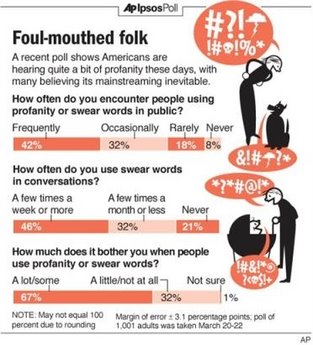
What, exactly, makes "fuck" more offensive than "fack"? Why is it the middle finger instead of the pinky that's so terribly shocking? For some reason, certain combinations of letters are utterly scandalous to people, and yet, we still have war, racism and homophobia (for starters). People find the strangest things to be offensive.

And it's pretty sad when the anachronistic Miss Manners says the most sensible thing in the whole article:
"Everybody is pretending they aren't shocked," Martin says, "and gradually people WON'T be shocked. And then those who want to be offensive will find another way."
Every day is incomplete until someone has been offended... that's my motto.

Tuesday, September 20, 2005

Language, longevity and book clubs

  • Natalie Angier sniffs around the notion of “dirty words” at the New York Times.
The notion of language being obscene and/or disgusting became utterly irrelevant to me the first time I ever saw what a bullet did to a living thing. Of course, if you torture and/or kill in the name of your country or your god, you’re in the clear. Humanity baffles me.
  • Carlos Fuentes fetes Cervantes’ Don Quixote and its influence on the literary form known as the novel.
I’ll be glad when Quixote’s 400th anniversary year is over so I can get back to enjoying the book again. The problem with something like Quixote is not that it’s overrated, per se, but that it sometimes doesn’t quite bear the weight of all the innovations it’s supposed to have ushered into existence. Nonetheless, Fuentes makes a number of good points about a novel’s shelf life, and how it can live far beyond its creator’s expectations.
  • Slate’s Fall Fiction Week closes out with Meghan O’Rourke’s adventures in unraveling The Sound and the Fury, with a little help from a certain book-loving talk-show host.
Either you go with Faulkner, or you don’t. Read this piece either way; O’Rourke’s take on him is insightful and practical. Oprah’s book club choices have been hit-and-miss with me -- most of the ones I’ve read, like Midwives, The Reader, Ellen Foster and House of Sand and Fog, didn’t add up to much -- so I have to give her credit for going with a trifecta of modernist classics that require a bit more effort to get through. But I daresay I kinda preferred it when she was introducing new authors to the scene. So much for that... thanks a lot, Franzen.

(Update, 9/22/05: The new book club selection from The Oprah is James Frey's memoir A Million Little Pieces. Ehhh... fine.)