Showing posts with label Author profile. Show all posts

Monday, November 21, 2005

Let us tend to our garden

François-Marie Arouet published Candide under the pen name Voltaire when he was 65; perhaps at that point he felt he had nothing left to lose. Whatever the backstory, it remains one of the most viciously funny satires ever conceived; its insane, freewheeling plot careens everywhere, kept on track only by the ruthlessness of Voltaire's wit. Simply put, it’s paced like a rocket, and will make you laugh like hell; it will also make you realize that the best comedy sports a pair of fangs.

Voltaire’s work apart from Candide is a bit harder to scrape together. (The Wikipedia entry on Voltaire claims he wrote several volumes of histories and 60 or more plays, in addition to his prose and poetry, but, as of this writing, it also claims that in 1715 he “returned to Paris to be a porn star.”) Surprisingly, much of his work has yet to be published in English; shorter works like Zadig and Micromegas are included in some editions alongside essays, letters and selections from his 1764 Philosophical Dictionary. Penguin’s The Portable Voltaire is probably the most wide-ranging collection of his work in English, but doesn’t include any of his plays or poems; another paperback edition from Signet Classics can help fill in some of the gaps.


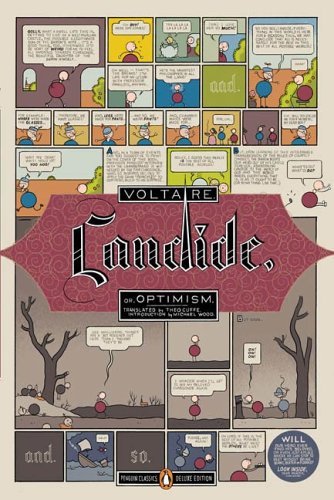
Candide’s story has taken many forms over the years; Leonard Bernstein turned it into an operetta in 1956, and Terry Southern and Mason Hoffenberg collaborated on a parody entitled Candy, published in 1958. English translations of the original French text are a dime a dozen, as well; among the most recent is a Modern Library edition translated by Peter Constantine, with a foreword by Diane Johnson. The newest, and most highly recommended, comes in the form of a Penguin Classics Deluxe Edition (seen above), sporting a new translation by Theo Cuffe and, best of all, delightful wraparound cover art by Chris Ware. With the long slog of the holiday season imminent, this is a perfect way to get a quick laugh, any time.

Monday, September 12, 2005

Author profile: Pauline Kael

Pauline Kael should have been a standup comic. She wrote film criticism instead; lucky for us. Not so lucky for the films, filmmakers and performers she zeroed in on:

On Return of the Jedi: “Even the scene that should be the emotional peak of the whole mythic trilogy -- the moment when the young protagonist, Luke Skywalker (Mark Hamill) removes the black visor and the helmet that have concealed Darth Vader’s face -- has no thrill. There isn’t a gasp to be heard in the entire theatre. Luke looks into the eyes of his nightmare father, and he might be ordering a veggieburger.
Kael was born in California in 1919. She was a philosophy major at the University of California, Berkeley, and parlayed that lucrative diploma into a patchwork career as a movie theatre manager. She flirted with radio and filmmaking early on, but it was her written descriptions of the films playing at her theatre that first caught attention. A notorious early stint at McCall’s, during which she famously trashed The Sound of Music, led her to The New Yorker, where she spent 23 years. She retired in 1991 and died after a long battle with Alzheimer’s disease on Sep. 3, 2001.

The act of deconstruction is a vicious thrill to every critic, and Kael’s writing style often convinced her readers that there was more bitter vitriol in her than celebratory adulations. She was a physically small woman (under five feet tall), which was a marked contrast to the authoritative boom of her writing. Automatic audience goodwill was a fallacy to her; what mattered most was the intoxicating, intensely vivid personal experiences that, she believed, only the movies had the power to convey. More than anything else, she valued films that were honest and direct in their intentions; she was as quick to celebrate pop filmmaking that went unashamedly for the gold as she was to denounce excessive self-consciousness and pretension.

She was, of course, controversial, not to mention undeniably influential. Peter Biskind’s gossipy Easy Riders, Raging Bulls depicts Kael as a starstruck member of the New York literati elite who was subject to hyperbole when it came to the work of filmmakers she was familiar with on a personal level, like Robert Altman, Brian DePalma and Martin Scorsese (claims Kael subsequently dismissed as specious), but it’s generally agreed that her insistent support of films like Bonnie & Clyde, MASH, Mean Streets and The Godfather helped play a crucial role in the film movement of the 1960s and 70s. She also was one of the first film critics to cross over to a job in the film business, as an “executive consultant” for Paramount, a job which lasted all of five months and inspired her most incisive, and prescient, piece on the state of the art, “Why Are Movies So Bad? Or, The Numbers” (June 23, 1980):
“There are direct results when conglomerates take over movie companies. At first, the heads of the conglomerates may be drawn into the movie business for the status implications -- the opportunity to associate with world-famous celebrities. Some other conglomerate heads may be drawn in for the girls, but for them, too, a new social life beckons, and as they become socially involved, people with great names approach them as equals, and it gets them crazy. Famous stars and producers and writers and directors tell them about offers they’ve had from other studios and about what ideas that they have for pictures, and the conglomerate heads become indignant that the studios they control aren’t in on those wonderful projects. The next day, they’re on the phone raising hell with their studio bosses. Very soon, they’re likely to be summoning directors and suggesting material to them, talking to actors, and telling the company executives what projects should be developed.”
Film criticism can sometimes be a lucrative gateway; Stephen Schiff, Rod Lurie, Stephen Hunter and Elvis Mitchell have followed in her footsteps, but few have Kael’s ferocious gift for it. You get the sense that her best work is done when she’s picking apart something that she can’t help but to love. What is most striking about Kael is her voice: passionate, tough and uncompromising. Alongside critics like Andrew Sarris, she brought artistic legitimacy to the form and captured, in her body of work, the electric excitement of creative revolution, and the crushing sadness of its increasingly-commercialized decline. In her introduction for For Keeps, a 1996 anthology of her work, she wrote:
“I’m frequently asked why I don’t write my memoirs. I think I have.”
Bibliography:
I Lost It at the Movies (1965)
Going Steady (1970)
Deeper Into Movies (1973) (winner of the National Book Award)
Kiss Kiss Bang Bang (1976)
Reeling (1977)
When the Lights Go Down (1980)
5001 Nights at the Movies (1982) (collected capsule reviews)
Taking It All In (1984)
State of the Art (1985)
Hooked (1989)
Movie Love (1991)
For Keeps (1996) (collected reviews & essays)

Featured in:
The Citizen Kane Book (1972) (essay “Raising Kane”)

Subject of:
Conversations with Pauline Kael by Will Brantley (1996)
Sontag & Kael: Opposites Attract Me by Craig Seligman
Afterglow: A Last Conversation with Pauline Kael by Francis Davis (2002)
- read excerpts at Salon

Further resources:
Ken Tucker surveys Kael’s career at Salon
Choice Kael quotes from BrainyQuotes
NPR’s collection of audio tributes to Kael from All Things Considered, David Thomson and Elvis Mitchell
Tuesday, September 06, 2005

Author profile: Stanley Elkin

Not long ago, a friend gave me a copy of Stanley Elkin’s novel A Bad Man. I’d never heard of him before; a number of his books have been republished by Dalkey Archive Press, but they’re not easily found everywhere. On the cover of the Avon trade paperback edition is, strangely, a quote taken from the novel itself:

They came to a last steel door. The guard moved Feldman against the wall with the muzzle of his machine gun. “Fix your tie,” he said, “or I’ll kill you.”
I’ve never been crazy about this kind of ad hype, but... that’s a good one.

A Bad Man concerns Leo Feldman, a department store owner whose obsessive need to provide everything (everything) for his customers eventually lands him in prison.

That’s about all the plot summary that can be managed, because Elkin’s narrative weaves off the tracks of reality around page 10 and realigns itself every once in a while, just to catch its breath. The prison is run by a Byzantine permission system that changes from inmate to inmate (and guard to guard). Feldman, upon arrival, is dressed in a blue “fool’s suit” (thus identifying him as a bad man); later he finds himself amidst a dinner party hosted by the warden; even later, he finds himself amidst the warden’s wife. Said warden reigns, godlike, over the prison, and seems to have chosen Feldman to be his special project.

It’s all very strange, and gloriously well-done at that; Elkin’s prose zigzags and corkscrews, his language sharp, his images startling:
There was only the breathing in all the cells. It was a sustained, continuous sigh, the men’s breath going and coming like hissed, sibilant wind. Somewhere down the cellblock he heard a toilet flush. Someone wrenched up phlegm from a sour throat. In their sleep men turned uncomfortably on their narrow cots. Rolling, they groaned. He heard farts, coughs, the clipped, telescoped declarations of dreamed speech. No one was escaping. All cells were locked. They were cornered, all of them. No one could get in.
Elkin was born in New York City in 1930, and apparently suffered from multiple sclerosis for most of his adult life (he died in 1995). Indeed, an attitude that one's own body is the worst prison imaginable permeates: there’s a lengthy sequence in A Bad Man where Feldman straps himself into an electric chair, in a desperate attempt to do what he thinks is the warden’s bidding. Issues of morality and ideology are Elkin’s primary concern; his characters are their own worst enemies, especially when imprisoned, with no one but themselves to answer to.

And the writing! Oh, my, the writing. Funny, prickly, cynical, outlandish. Elkin is a writer’s writer, in the sense that plot takes a backseat to the prismatic expression of ideas. He taught at Washington University in St. Louis, Missouri until his death, and like his contemporaries he viewed the style of the 19th-century novel to be hopelessly out of date in a culture where the threat of total global annihilation is very real. He’s one of those writers whose technique is stronger than his storytelling; you don’t necessarily care what he’s saying, but how he’s saying it. Surrealistic touches in an Elkin novel aren’t as gimmicky as they might be in one by, say, Tom Robbins; Elkin crawls right down to his characters’ levels, however low they might be, and sees, through their eyes, a world run mad by order.

Bibliography:

Boswell: A Modern Comedy (1964)
A Bad Man (1965)
Criers and Kibitzers, Kibitzers and Criers: Stories (1966)
The Dick Gibson Show (1970)
Searches and Seizures: Three Novellas (1973)
The Franchiser (1976)
The Coffee Room (1978) (radio play)
The Living End (1979)
George Mills (1982)
Early Elkin (1985)
The Magic Kingdom (1985)
The Rabbi of Lud (1987)
The Six-Year-Old Man (1988)
The MacGuffin (1991)
Pieces of Soap: Essays (1992)
Van Gogh’s Room at Arles: Three Novellas (1992)
Mrs. Ted Bliss (1995)

Further resources:

“Reading Stanley Elkin” by Rick Moody
September 1974 interview with Stanley Elkin from The Paris Review (PDF)
Encarta entry on Stanley Elkin

Friday, August 26, 2005

Author profile: Arthur Koestler

A few years ago I read an interview in The New York Times with some members of the writing staff of The Simpsons. One of them -- I can’t remember who -- mentioned Arthur Koestler’s book The Act of Creation in passing, as part of a well-articulated point about the conflicting nature of comedy. I subsequently spent years looking for it -- fruitlessly, because it was, of course, out of print. I finally found a used copy online not long ago.

Koestler had a crazy, Cervantes-esque life. He was born into a German-speaking Hungarian Jewish family in 1905. During a stint as a journalist covering the Spanish Civil War, he was captured and held prisoner for several months, an experience which formed the basis for his 1940 novel Darkness at Noon. He became a British subject during WWII and became well-known in the postwar period for his writing, which spanned from politics and science to philosophy and mysticism. He was an early advocate of euthanasia and committed suicide while terminally ill, along with his wife (who was apparently in good health), in 1983.

The Act of Creation is the second in a trilogy (the others being The Sleepwalkers and The Ghost in the Machine) of examinations of life sciences and the human mind, and it’s really, really interesting -- written clearly and engagingly, without impenetrable jargon. Koestler’s basic idea is that there are “matrices” or patterns of thought that govern the human animal, and that the creative act is the “bisociation,” as he puts it, of two (or more) apparently incompatible frames of thought -- the creative act is the working-out of the new matrix. It's informative and enlightening across the board -- Koestler’s great gift is laying out the whys and hows of the creative process has evolved and how ideas can, and must, evolve along with it.

Selected quotes from The Act of Creation:

"The impersonator is two different people at one time. If the result is degrading, the spectator will laugh. If he is led to sympathize or identify himself with the impersonated hero, he will experience that state of split-mindedness known as dramatic illusion, or 'the magic of the stage.'"

"The humorist thrives on deformity; the artist deforms the world to recreate it in his own image."

"...to a sophisticated audience any joke sounds stale if it is entirely explicit."

"...discovery often means simply the uncovering of something which has always been there but was hidden from the eye by the blinkers of habit."

"...we may distinguish between the biological ripeness of a species to form a new adaptive habit or acquire a new skill, and the ripeness of a culture to make and exploit a new discovery."

Regarding Darwin: "Here is one of the cases where the process of elaboration, verification and confirmation -- the long donkey-work following the brief flash of insight -- is more decisive than the discovery itself."

"...static vision does not exist; there is no seeing without exploring."

"...distrust of words is a trait often found among those who create with their eyes."

"...the tragedian creates illusion, the comedian debunks illusion; the therapist does both."

"Imagination is at once the source of all hope and inspiration but also of frustration -- to forget this is to court despair."

"...the tragedies of science are the slayings of beautiful hypotheses by ugly facts."

"The consumer hopes that by being allowed to share the creator's vision he will gain a deeper and broader view of reality. The producer has an urge to share his own experience with others -- to win accomplices to his malice, partners in understanding, resonance for his emotions."

"Righteous indignation about injustices inflicted on others can generate behavior just as fanatical as the sting of a personal insult. Self-sacrificing devotion to a creed bred ruthless inquisitors -- 'the worst of madmen is a saint run mad.'"

Bibliography:
- Spanish Testament (1937)
- The Gladiators (1939)
- Darkness at Noon (1940)
- Arrival and Departure (1943)
- Twilight Bar (1945)
- The Yogi and The Commissar and Other Essays (1945)
- Thieves in the Night (1946)
- The Challenge of Our Time (1948)
- Promise & Fulfillment: Palestine 1917-1949 (1949)
- Insight & Outlook (1949)
- The Age of Longing (1951)
- The Trail of the Dinosaurs and Other Essays (1955)
- Reflections on Hanging (1956)
- The Sleepwalkers (1959) (abridged edition published in 1960 as The Watershed)
- The Lotus and The Robot (1960)
- Control of the Mind (1961)
- Hanged by the Neck (1961)
- Suicide of a Nation? (1963)
- The Act of Creation (1964)
- Studies in Psychology (1965)
- The Ghost in the Machine (1967)
- Drinkers of Infinity: Essays 1955-1967 (1968)
- Beyond Reductionism: New Perspectives in the Life Sciences (1969) (with J. R. Smythies)
- The Case of the Midwife Toad (1971)
- The Call Girls: A Tragicomedy with a Prologue and Epilogue (1972) (play)
- The Roots of Coincidence (1972)
- The Lion and The Ostrich (1973) (pamphlet)
- The Heel of Achilles: Essays 1968-1973 (1974)
- The Thirteenth Tribe (1976)
- Janus: A Summing Up (1978)
- Bricks to Babel: Collected Extracts (1980)

Autobiography:
- The Scum of the Earth (1941)
- Arrow in the Blue (1952)
- The Invisible Writing (1954)
- Stranger in the Square (1980) (with Cynthia Koestler)

Contributed to / featured in:
- The God That Failed (1949) (essay) (edited by Richard H. Crossman)
- The Challenge of Chance: A Mass Experiment in Telepathy and Its Unexpected Outcome (1973) (edited by Allister Hardy)
- Life After Death (1976) (co-editor)

Further resources:
Arthur Koestler entry at Wikipedia
Small collection of Koestler writings at the Arthur Koestler Project