Showing posts with label Voltaire. Show all posts

Friday, June 02, 2006

Street lit, Voltaire's letters, and recommendations

  • Brendan Koerner introduces the whiteys to street lit at Slate.
First it was "chick lit," then it was "lad lit," and now here comes "street lit," here exemplified by an admittedly entertaining-sounding tome called Candy Licker, the author going by the nom de plume Noire (of course). This is oh so much marketing crap, these "[fill-in-the-blank] lit" categorizations, evidence of advertisers trying to create trends where none actually exist, and it's disheartening to see advertising approaches for books focusing on narrower and narrower markets. Nevertheless, solicitations aside, they'll still end up being subjected to the same test as every other piece of writing: is it any good?
  • A Russian art dealer has purchased the correspondence of Voltaire and Catherine the Great.
Thomas Bompard, a manuscript expert at Sotheby's in Paris who looked after the archive, said: "Voltaire and Catherine never met, but the relationship between these great characters of the 18th century was conducted through these letters." The most telling comments in the letter for today's Russia refer to Catherine's governing style. Mr Bompard said Voltaire, who lambasted the French monarchy during the Enlightenment for its excesses, approved of her role as an "enlightened despot". Catherine, who ruled Russia for three decades until her death in 1796, viewed herself a patron of the arts and liberty, and a "philosopher on the throne", but has been criticised for the little she did for the millions of peasants in her empire.
Ah, well. At least we still have Candide to remember him by.
This is similar to the recommendations offered by Amazon and Netflix, in that the site tailors its recommendations to you based on the ratings you assign to what you've read in the past. It's not exactly comprehensive; I entered the book I'm reading now (The Magic Kingdom by Stanley Elkin) and came up with a recommendation for a Doctor Who book, which isn't quite to my taste. Then I entered Gravity's Rainbow and came up with recommendations for books by William Least Heat-Moon, Erich Maria Remarque, William Gaddis and others, some of which I've actually read, too, so it's not a total wash. You can also take a "What have I read?" test that will help refine your recommendations; it's a pretty fun way for a book lover to kill some time.

Tuesday, December 27, 2005

Looky looky I got booky

Gotta love it when books are gifts:

  • H. L. Mencken on Religion, edited by S. T. Joshi - a surprise gift from some old friends. Mencken’s no angel and he does his share of fence-straddling, but for the most part his observations are still as cutting and prescient as they were eighty years ago. Of particular note are his writings on the Scopes trial, especially interesting reading in these heady days of “intelligent design.”

  • How the Grinch Stole Christmas by Dr. Seuss - I had forgotten how Seuss could make a wintry landscape look edible; the snow looks like cake icing. And I still think someone will discover an alternate ending buried in some dusty trunk, one in which the Grinch marinates the roast beast with strychnine.

  • 1491: New Revelations of the Americas Before Columbus by Charles C. Mann - I hope this is as interesting as it looks. In the current climate of obtuse nationalism it's beneficial to look beyond the boundaries of an institution, and from the few pages I've sampled so far this looks to be enlightening. End pretentious windbagging.

  • Bradbury Stories by Ray Bradbury - What a wonderful collection. Bradbury’s style is exquisite; florid, yes, but vivid and tactile. He creates worlds you ache to get lost in.

  • McSweeny's Quarterly Concern, Issue 13, guest-edited by Chris Ware - A great find. Ware’s “temporary” stint as editor features his usual jam-packed, elaborately-designed scheme, but there’s more to chew on than just the comics (which are great); there’s an interesting essay by John Updike and a Ware-penned appreciation of an intriguing gallery artist named Philip Guston.

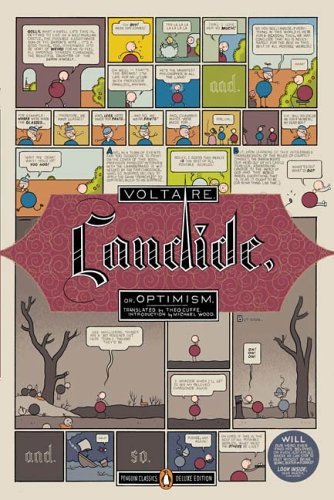
  • Candide by Voltaire - Continuing the Ware deluge, this is the edition I profiled in November, with his witty wraparound cover design. Included as a special bonus is the complete text of Candide, too, so it’s double the fun.

  • The Early Stories 1953-1975 by John Updike - This one will be fun to dive into. Short-story collections are great to have on hand for lunch breaks, and Updike does ‘em awfully well.

  • Marcel Proust: A Life by Jean Yves Tadie - I will never, ever read all of this (986 pages that could double as a murder weapon), but it was a steal at $4 and I love Proust’s books. I think it’s interesting how you read a bio of a famed personality and all in all, their lives end up being just like everyone else’s: a long string of good times and bad times alike.

  • The Professor and the Madman by Simon Winchester - Book-dork nirvana, from the looks of it. I’ve heard nothing but good things.

  • Blonde by Joyce Carol Oates - I’ve read a bunch of Oates’ short stories, but never a novel. The time is drawing nigh.

Monday, November 21, 2005

Let us tend to our garden

François-Marie Arouet published Candide under the pen name Voltaire when he was 65; perhaps at that point he felt he had nothing left to lose. Whatever the backstory, it remains one of the most viciously funny satires ever conceived; its insane, freewheeling plot careens everywhere, kept on track only by the ruthlessness of Voltaire's wit. Simply put, it’s paced like a rocket, and will make you laugh like hell; it will also make you realize that the best comedy sports a pair of fangs.

Voltaire’s work apart from Candide is a bit harder to scrape together. (The Wikipedia entry on Voltaire claims he wrote several volumes of histories and 60 or more plays, in addition to his prose and poetry, but, as of this writing, it also claims that in 1715 he “returned to Paris to be a porn star.”) Surprisingly, much of his work has yet to be published in English; shorter works like Zadig and Micromegas are included in some editions alongside essays, letters and selections from his 1764 Philosophical Dictionary. Penguin’s The Portable Voltaire is probably the most wide-ranging collection of his work in English, but doesn’t include any of his plays or poems; another paperback edition from Signet Classics can help fill in some of the gaps.


Candide’s story has taken many forms over the years; Leonard Bernstein turned it into an operetta in 1956, and Terry Southern and Mason Hoffenberg collaborated on a parody entitled Candy, published in 1958. English translations of the original French text are a dime a dozen, as well; among the most recent is a Modern Library edition translated by Peter Constantine, with a foreword by Diane Johnson. The newest, and most highly recommended, comes in the form of a Penguin Classics Deluxe Edition (seen above), sporting a new translation by Theo Cuffe and, best of all, delightful wraparound cover art by Chris Ware. With the long slog of the holiday season imminent, this is a perfect way to get a quick laugh, any time.