Showing posts with label Chris Ware. Show all posts

Tuesday, December 27, 2005

Looky looky I got booky

Gotta love it when books are gifts:

  • H. L. Mencken on Religion, edited by S. T. Joshi - a surprise gift from some old friends. Mencken’s no angel and he does his share of fence-straddling, but for the most part his observations are still as cutting and prescient as they were eighty years ago. Of particular note are his writings on the Scopes trial, especially interesting reading in these heady days of “intelligent design.”

  • How the Grinch Stole Christmas by Dr. Seuss - I had forgotten how Seuss could make a wintry landscape look edible; the snow looks like cake icing. And I still think someone will discover an alternate ending buried in some dusty trunk, one in which the Grinch marinates the roast beast with strychnine.

  • 1491: New Revelations of the Americas Before Columbus by Charles C. Mann - I hope this is as interesting as it looks. In the current climate of obtuse nationalism it's beneficial to look beyond the boundaries of an institution, and from the few pages I've sampled so far this looks to be enlightening. End pretentious windbagging.

  • Bradbury Stories by Ray Bradbury - What a wonderful collection. Bradbury’s style is exquisite; florid, yes, but vivid and tactile. He creates worlds you ache to get lost in.

  • McSweeny's Quarterly Concern, Issue 13, guest-edited by Chris Ware - A great find. Ware’s “temporary” stint as editor features his usual jam-packed, elaborately-designed scheme, but there’s more to chew on than just the comics (which are great); there’s an interesting essay by John Updike and a Ware-penned appreciation of an intriguing gallery artist named Philip Guston.

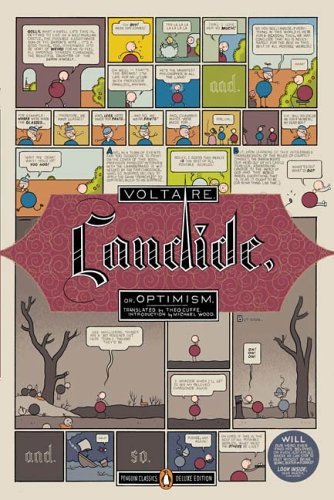
  • Candide by Voltaire - Continuing the Ware deluge, this is the edition I profiled in November, with his witty wraparound cover design. Included as a special bonus is the complete text of Candide, too, so it’s double the fun.

  • The Early Stories 1953-1975 by John Updike - This one will be fun to dive into. Short-story collections are great to have on hand for lunch breaks, and Updike does ‘em awfully well.

  • Marcel Proust: A Life by Jean Yves Tadie - I will never, ever read all of this (986 pages that could double as a murder weapon), but it was a steal at $4 and I love Proust’s books. I think it’s interesting how you read a bio of a famed personality and all in all, their lives end up being just like everyone else’s: a long string of good times and bad times alike.

  • The Professor and the Madman by Simon Winchester - Book-dork nirvana, from the looks of it. I’ve heard nothing but good things.

  • Blonde by Joyce Carol Oates - I’ve read a bunch of Oates’ short stories, but never a novel. The time is drawing nigh.

Monday, November 21, 2005

Let us tend to our garden

François-Marie Arouet published Candide under the pen name Voltaire when he was 65; perhaps at that point he felt he had nothing left to lose. Whatever the backstory, it remains one of the most viciously funny satires ever conceived; its insane, freewheeling plot careens everywhere, kept on track only by the ruthlessness of Voltaire's wit. Simply put, it’s paced like a rocket, and will make you laugh like hell; it will also make you realize that the best comedy sports a pair of fangs.

Voltaire’s work apart from Candide is a bit harder to scrape together. (The Wikipedia entry on Voltaire claims he wrote several volumes of histories and 60 or more plays, in addition to his prose and poetry, but, as of this writing, it also claims that in 1715 he “returned to Paris to be a porn star.”) Surprisingly, much of his work has yet to be published in English; shorter works like Zadig and Micromegas are included in some editions alongside essays, letters and selections from his 1764 Philosophical Dictionary. Penguin’s The Portable Voltaire is probably the most wide-ranging collection of his work in English, but doesn’t include any of his plays or poems; another paperback edition from Signet Classics can help fill in some of the gaps.


Candide’s story has taken many forms over the years; Leonard Bernstein turned it into an operetta in 1956, and Terry Southern and Mason Hoffenberg collaborated on a parody entitled Candy, published in 1958. English translations of the original French text are a dime a dozen, as well; among the most recent is a Modern Library edition translated by Peter Constantine, with a foreword by Diane Johnson. The newest, and most highly recommended, comes in the form of a Penguin Classics Deluxe Edition (seen above), sporting a new translation by Theo Cuffe and, best of all, delightful wraparound cover art by Chris Ware. With the long slog of the holiday season imminent, this is a perfect way to get a quick laugh, any time.

Thursday, October 20, 2005

Call it "visual literature"

I’ll admit it -- I’m one of those narrow-minded snob assholes whose brain shuts off when a comic book crosses my vision. You know the cliché, the ones where all the men look like Schwarzenegger and all the women look like no woman ever looked. I’ve never cared much for superhero comics; in my brief comics phase when I was a kid, I leaned more towards the old E.C. horror books published by William Gaines, like Vault of Horror and Tales from the Crypt.

The forward-march of the comics world is kind of old news at this point; both mainstream and literary authors have been taking tricks from them for years. Stephen King’s E. C. tributes include his graphic novels Cycle of the Werewolf and Creepshow (both with art by Berni Wrightston). Mark Z. Danielewski’s 2000 novel House of Leaves resembles a scrapbook, from which an engagingly fractured narrative emerges. And Jonathan Safran Foer’s Extremely Loud and Incredibly Close plays similar games with typography, photos and a flip-book effect at the book’s close that serves as its final, haunting image. Comics may not be revolutionary in and of themselves, but their influence on other literary forms is, at this point, undeniable.

These days, write-ups in The New York Times Magazine give them a patina of respectability, which demands that the label be “graphic novel” or “comix;” whatever it takes to separate the healthy main course from the junk food. That comic-book-based film franchises like Spider-Man and X-Men are far better than most typical Hollywood tentpoles has everything to do with the fact that each has a tremendous well of source material to draw from, however pulpy. And it’s ironic, albeit unsurprising, that the films of two of the comics world’s more venerated “literary” works -- Alan Moore’s From Hell and John Wagner’s A History of Violence -- eventually reached the screen with their storylines severely truncated and/or reworked, and in each case for the worse; each film did away with practically everything about the source novel that was interesting in the first place. When businessmen and focus groups call the shots, expect only tits, gore and explosions for your dollar. (Unless that’s the book’s raison d’etre; ergo, Sin City.)

I bring up the film adaptations only because comic books and graphic novels owe much to the movies, and vice versa; both are a mash-up of literary and visual storytelling. Whereas mainstream popular filmmaking has essentially flatlined (and will continue to devolve as long as the corporate-controlled studio system remains in place), graphic novels are taking major strides in innovative directions, if only because, for the moment, it seems like the inmates are running the asylum.

If there’s an enfant terrible of the current comix scene, it’s probably Chris Ware, for better or for worse. His Quimby the Mouse, for example, is an enormous coffee-table-sized book with so much visual and literary content jammed into 56 pages you reel from sensory overload the second you open it. In his Jimmy Corrigan, the Smartest Kid on Earth, panels crawl backwards, forwards, upside-down and in circles on the page, making finding the next frame just as much of a challenge as deciphering its storyline. All of this show-off technique, however, only serves the narrative, and it’s a doozy: an exquisitely sad evocation of loneliness and familial history so wrenching that at times it’s hard to keep turning the pages. Ware’s bratty, to be sure, and his reach sometimes exceeds his grasp, but at least he’s reaching to begin with.

Not all of them are impenetrable, however. Craig Thompson’s Blankets tells a very simple first-love story, between cloistered young teenagers who meet at Bible camp, with great dexterity and emotional resonance. Thompson’s wintry landscapes are evocatively rendered, and his artistic flights of fancy are mostly earned; they crescendo in an extraordinary frame where a car containing one of the young lovers drives out of the other’s life -- and off the edge of the earth. His earlier book Goodbye, Chunky Rice tells a similarly poignant tale, albeit in a more oblique fashion (here’s the moment to apply that first-book curve).

Marjane Satrapi’s Persepolis and its sequel have gotten a lot of press, as has Art Spiegelman, who arguably created the long-form literary graphic novel with his Maus series and, more recently, put out an amazing oversized collection called In the Shadow of No Towers, featuring his unforgettable post-9/11 New Yorker cover painting. And Alex Robinson has carved a Nick Hornby-esque niche out for himself with his books Box Office Poison and Tricked. The field of literary comics has also been helped tremendously by publishers like Atlanta-based Top Shelf Productions, who have created a kind of safe haven for up-and-coming artists to thrive; they currently boast Thompson, Robinson, Moore, Eddie Campbell, Ed Brubaker and James Kochalka among their stable.

Oh, just try one.