Showing posts with label Thomas Pynchon. Show all posts

Monday, December 15, 2008

Pynchon alert

Coming summer '09. The synopsis, from ThomasPynchon.com:

It's been awhile since Doc Sportello has seen his ex-girlfriend. Suddenly out of nowhere she shows up with a story about a plot to kidnap a billionaire land developer whom she just happens to be in love with. Easy for her to say. It's the tail end of the psychedelic sixties in L.A., and Doc knows that "love" is another of those words going around at the moment, like "trip" or "groovy," except that this one usually leads to trouble. Despite which he soon finds himself drawn into a bizarre tangle of motives and passions whose cast of characters includes surfers, hustlers, dopers and rockers, a murderous loan shark, a tenor sax player working undercover, an ex-con with a swastika tattoo and a fondness for Ethel Merman, and a mysterious entity known as the Golden Fang, which may only be a tax dodge set up by some dentists.
And it's less than half the length of Against the Day, too, which bodes well for it actually getting read.

Thursday, July 26, 2007

A lack of ambivalence

Worth reading, if only for the bit about Pynchon.
Guernica: In a number of your past books, your characters have also expressed ambivalent feelings about the idea of terrorism. In the opening of Players, you describe the “glamour of revolutionary violence, the secret longing it evokes in the most docile soul...” And in Mao II one of the characters says of terrorists, “It’s difficult when they kill and maim because you see them honestly now as the only possible heroes for our time... the way they live in the shadows, live willingly with death.” Did what happened on September 11th change your own thoughts about terrorism?

Don DeLillo: No. I tend to write through character consciousness, and different people in my books have different feelings about this matter. One of the characters in Falling Man, Martin, makes a greater attempt to understand the complaints against the narcissistic heart of the West. The character he argues with, Nina, does not disagree with this in theory, but when the attacks occur, something else occurs, which is a terrible outrage.

Guernica: Did you struggle with similar responses yourself, after the attacks?

Don DeLillo: No, I didn’t struggle. I knew I was totally opposed to what happened and to the reason for it.

Friday, April 27, 2007

We now return to our regularly scheduled programming

Getting back to it.

Ferris, the author of the current talk-of-the-literati workplace novel Then We Came to the End, gets in some good observations. You might almost consider this a commentary track for his book:
Work, then - broadly defined - is central to literature. Don Quixote goes headlong into the windmill - what is the noble fool doing but his misguided work? Work puts Ishmael on the Pequod. Work brings Esther to Bleak House and sends Humbert Humbert to the house on Lawn Street. Work defines the plot and central moral conceit of Ian McEwan's Saturday. Work as wayward scientific inquiry prompts Tyrone Slothrop's erections during the Blitz and forces him out into the Zone in Thomas Pynchon's Gravity's Rainbow, while work as blind loyalty reveals the trouble with blind loyalty in Kazuo Ishiguro's The Remains of the Day. These examples highlight how vocation in literature is never happenstance, never half-hearted decision-making, but artfully premeditated and always purposeful. Work does work in every great book - even if just to allow the characters enough leisure time to pursue the main drama.

As strategically and thematically smart as Fitzgerald is when assigning vocations to his characters - vocations that aid and abet by professional title the novel's personal drama - he nevertheless keeps work-related matters topical. It is the nature of the work, not the work itself, that informs. A different story arises when a writer chooses to go deeper into work, to turn work into one of literature's main characters.

Friday, March 02, 2007

Ever the contrarian

  • James Wood takes on Thomas Pynchon's Against the Day.
Whether or not you agree with Wood's dismissal of what he's infamously termed "hysterical realism", he certainly argues his points well.
This is doubtless a rough division, but it has some application to the contemporary postmodern novel. Commentators like to go on about Thomas Pynchon's daunting modernity -- the indexical learning, the fierce assays and essays in thermodynamics and polymers and mathematics, the brilliant parodies and pastiches of different novel genres -- but fewer point out that in some ways he is a very old-fashioned novelist, one whom Fielding (and Cervantes, for that matter) would instantly recognize. Mason & Dixon, written in a flawless pastiche of eighteenth-century prose, was not eccentric, but the logical fruit of Pynchon's aesthetic interests: a busy eighteenth-century novel -- itself already, in some ways, a "postmodern" artifact, because a self-conscious one -- selfconsciously rewritten by a twentieth-century postmodernist.

There is nothing more eighteenth century than Pynchon's love of picaresque plot-accumulation, his mockery of pedantry which is at the same time a love of pedantry, his habit of making his flat characters dance for a moment on stage and then whisking them away, his vaudevillian fondness for silly names, japes, mishaps, disguises, farcical errors, and so on. His characters sit down and lengthily, larkily "dispute" ideas with each other as if sitting in roadside taverns and sharing pipes and pots of ale. As Fielding is an ironist, insisting on his own moralism while apparently undermining its grounds, so Pynchon likes to promote meaning and then sack it for getting above itself.

Friday, January 05, 2007

Swallowing the world, or: Sex, paranoia and rockets

Notes on Gravity's Rainbow

So I read Thomas Pynchon’s novel Gravity’s Rainbow.

And, uh… yeah.

It’s like Jackson Pollock loaded a shotgun with buckshot made out of the Oxford English Dictionary and blazed away. That’s the first thing: it’s writing gone splatterpunk. The second thing is, after 700+ pages you may want to use that shotgun on yourself. It’s like being nose-to-nose with a speed freak shrieking about rockets, war, sex, paranoia, harmonicas, sadomasochism, coprophagia, more paranoia, hallucinations, physics, erections, conspiracies, an octopus, séances, hashish, orgies, anarchy, endless lists and, just for good measure, even more paranoia. There's a scene where the passengers of a hot-air balloon battle off a fighter plane with custard pies. There's endless discussions of rocket science, parabolic arcs, psychology theory, nuclear energy, chemical engineering. There's a family history of a goddamned light bulb.

Nothing succeeds like excess, the adage goes, and excess is Gravity’s Rainbow’s specialty. It’s a book that defies every rule of writing imaginable. It’s maddening, egotistical, obtuse, exhausting, even torturous. That it’s also brilliant is almost beside the point. Almost. If you believe that anything worthwhile is going to involve a bit of pain, well, step right up, the cat-o-nine-tails will a-whistle tonight.

Yeah, it’s a good book. A great book. A pinnacle of the craft of literary fiction. They haven’t trotted out all those superlatives since 1973 for nothing. And I honestly cannot wait to read it again. But a book of this scope demands a commitment that you might save for a significant other. It’s a relationship that you get into, with this Thomas Pynchon character. You might love him with all your heart, but other times you might simply want him to leave you the hell alone. Maybe that’s why he’s so infamously reclusive. The book’s such a great big sticky massive gob of contradictory, complicated, infuriating whatever-the-hell-it-is that Pynchon’s appearing in public would be totally redundant. The only other thing in this world that's a more glorious, exultant mess is humanity itself.

It’s everything. That’s what I first thought when I started. There’s seemingly nothing that escapes its gaze. (Apparently, everything that did escape ended up in Against the Day.) About 200 pages in I wrote “LOOK AT EVERYTHING” on a blue Post-It note and stuck it on the inside front cover of the old Bantam mass-market paperback copy I have (liberated from a used-bookstore rack in Asheville, North Carolina for $1.25). Pynchon can’t get enough of the world. It seems like there’s nothing that he doesn't want to shoehorn in -- he can't help himself. If you want a man trying to play God on a high-wire, Pynchon’s it. There’s nothing too high, too low. To him, the world has already gone to hell, and he’s helping himself to the detritus, and trying to rebuild it in his own image.

“Postmodernism” is one of those empty college-campus phrases that will cease to mean anything by the time that those that coined it have stopping walking the earth. Pynchon’s work is considered to be amongst those other writers of his era – Barth, Vonnegut, Robbins, et al – because language is his plaything, not necessarily a vessel for his story. With Barth, there’s a sense of exuberance, joy; wild enthusiasm in both the possibilities of language and his own capabilities. Pynchon’s approach is desperate, clamoring; he’s obsessed with getting through to you and yet he can’t say enough, he doesn’t know how to stop. And in not being able to say enough, he sometimes says nothing at all. Pynchon is a member of the first generation to grow up under the dark shadow of nuclear power – mankind’s hitherto unprecedented ability to destroy every living thing on the planet. I suppose that’s what the professors mean when they say “postmodern” – the intrinsic sense that the end of the rope is coming, that it’s a long way down. A little desperation in the face of that shouldn’t be all that surprising anymore.

Should you read it? Hell, yes. Pencil in a couple of months, though, and drink lots of echinacea tea. War and Peace is a breeze in comparison. (Seriously.) You come out of it scarred, bruised, dazed. But you won’t trade the experience for anything, because by then you’ll know that nothing that’s worthwhile is ever easy.

Monday, December 18, 2006

The bad and the great

With best-of listmania sweeping the land, the inevitable inverse is becoming popular. (See here and here.) So here's my dos pesos on some books that didn't ring my bell over the last year.

  • On the Road by Jack Kerouac: Meh. Egomaniacs on drugs. Repeat for 250 pages.
  • Middlesex by Jeffrey Eugenides: Gorgeously written, yes. But goes way overboard on melodramatic plot twists. And it stops just when it's getting interesting.
  • Sunset and Sawdust by Joe R. Lansdale: Terrific opening sequence [heroine shooting her abusive husband as a tornado wrecks their home]. Sloppy patchwork mystery plotting for the remaining time, replete with corny Texas-twang dialogue and oh-so-odious bad guys. Energetic but sadly nothing new.
  • The Sea by John Banville: Gonna have to agree with Book World on this. Pretty language does not a compelling tale make.
Not to be too negative... here's my favorite reads from this year:
  • Veronica by Mary Gaitskill: Harshly beautiful; prose like a diamond knife. Sad, haunting, and hard to forget.
  • Beasts of No Nation by Uzodimna Iweala: What a debut. A prose voice like none you've ever read.
  • The Master and Margarita by Mikhail Sholokov: What great fun. Gogol on acid; freakishly inventive, fearless.
  • M31: A Family Romance by Stephen Wright: Incandescent. For my money, Wright's one of the best writers working today.
  • Out of the Woods by Chris Offutt: Short stories with incredible clarity, precision and control. Not a wasted word, not an unfelt moment.
  • Gravity's Rainbow by Thomas Pynchon: The head, the tail, the whole damn thing. It isn't hype; it's everything, and more.

Wednesday, December 06, 2006

The system

"Taking and not giving back, demanding that "productivity" and "earnings" keep on increasing with time, the System removing from the rest of the World these vast quantities of energy to keep its own tiny desperate fraction showing a profit: and not only most of humanity -- most of the World, animal, vegetable and mineral, is laid waste in the process. The System may or may not understand that it's only buying time. And that time is an artificial resource to begin with, of no value to anyone or anything but the System, which sooner or later must crash to its death, when its addiction to energy has become more than the rest of the World can supply, dragging with it innocent souls all along the chain of life. Living inside the System is like riding across the country in a bus driven by a maniac bent on suicide... though he's amiable enough, keeps cracking jokes back through the loudspeaker..."

-- from Gravity's Rainbow

It speaks

Thomas Pynchon, who vies with J D Salinger for the title of the world's most secretive author, has broken his strict rules on privacy to join a campaign to clear the British Booker Prize-winning novelist Ian McEwan of charges of plagiarism.

In a move described by his British publisher as "unknown", Pynchon, an American who is never seen in public, does not give interviews and whose whereabouts are a closely guarded secret, sent a typed letter to his British agent yesterday to say that McEwan "merits not our scolding but our gratitude" for using details from another author's book.
More at the New York Times.

Monday, November 20, 2006

The war machine

"Don't forget the real business of the War is buying and selling. The murdering and the violence are self-policing , and can be entrusted to non-professionals. The mass nature of wartime death is useful in many ways. It serves as spectacle, as diversion from the real movements of the War. It provides raw material to be recorded into History, so that children may be taught History as sequences of violence, battle after battle, and be more prepared for the adult world. Best of all, mass death's a stimulus to just ordinary folks, little fellows, to try 'n' grab a piece of that Pie while they're still here to gobble it up. The true war is a celebration of markets. Organic markets, carefully styled "black" by the professionals, spring up everywhere. Scrip, Sterling, Reichsmarks continue to move, severe as classical ballet, inside their antiseptic marble chambers. But out here, down here among the people, the truer currencies come into being."

-- from Gravity's Rainbow

Thursday, October 12, 2006

Obligatory awards roundup

  • This year's Nobel Prize winner for literature: Orhan Pamuk.
The selection of Pamuk, whose recent trial for ''insulting Turkishness'' raised concerns about free speech in Turkey, continues a trend among Nobel judges of picking writers in conflict with their own governments. British playwright Harold Pinter, a strong opponent of his country's involvement in the Iraq war, won last year. Elfriede Jelinek, a longtime critic of Austria's conservative politicians and social class, was the 2004 winner.
A notable lack of the heavy hitters with new books out (McCarthy, Pynchon, Roth, et al). Still, maybe this will turn more people onto Powers' stuff.
She becomes the youngest ever woman to win the prize, doing one better than her mother, Anita Desai, who was nominated for the award three times, most recently in 1999, but failed to win.

Kiran Desai's book [The Inheritance of Loss] was hailed by the judges as "a magnificent novel of humane breadth and wisdom, comic tenderness and powerful political acuteness".

Accepting her award, she praised her mother, to whom she said she owes "a debt so profound and so great that this book feels as much hers as it does mine."
Apparently there's now something called the Quills, which sounds like a rather desperate attempt on the behalf of the publishing industry to sex up its image by tossing celebrities and an NBC television broadcast into the mix. The top book prize went to Tyler Perry. The defense rests.

And somehow I missed this when it was announced, but:
Other recipients include writers David Carroll, Atul Gawande, Adrian LeBlanc, David Macaulay and Sarah Ruhl, as well as musician John Zorn (a personal favorite, yay for that).

Friday, October 06, 2006

Notes from Frankfurt

The Frankfurt Book Fair is going on as we speak. Here's some of the highlights:

Shocker.
Ditto.

Thankfully, GalleyCat is there with some real news, most notably a roundup of the big deals:
Woody Allen's MERE ANARCHY, his first collection of comic writing since his celebrated 1970s books GETTING EVEN and WITHOUT FEATHERS, will be out in August 2007, when Random House US and Ebury will publish the book at the same time. Meanwhile, Felicity Bryan has concluded 'substantial' US and French deals for the latest novel by Iain Pears with Julie Grau at Spiegel & Grau/Doubleday and Francois Triffault at Belfond. STONE'S FALL, will be delivered next year.
Meanwhile, over at the NBCC, John Freeman has gotten his hands on Against the Day. Bastard.

Friday, September 08, 2006

Pynchon update

It's now officially a doorstop at 1,040 pages.

Tuesday, August 01, 2006

Bargain alerts

Get 'em while you can:

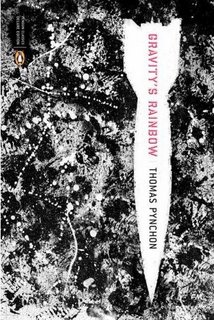
A pretty cool series of classics with cover designs by comic artists. By the way, the 2nd round is due in October, featuring an edition of Thomas Pynchon's Gravity's Rainbow with cover art by none other than Frank Miller:

Alas, this one is not part of the buy-one-get-one deal, but hey, you can't have everything in life.
Simenon's a pretty interesting writer, and an astonishingly prolific one at that; according to Wikipedia, "his oeuvre include nearly 200 novels, over 150 novellas, several autobiographical works, numerous articles, and scores of pulp novels written under more than two dozen pseudonyms." I read his Tropic Moon earlier this year and liked it; it's a trim, Jim Thompson-esque hardboiled noir set in a sweltering African outpost. Simenon's style is lethally precise, and despite the genre familiarity of his plots, the writing is often exquisite.

Thursday, July 20, 2006

A screaming comes across the Web

The description has, as of this writing, since disappeared from the page itself, but quick-thinking readers on the Amazon forums managed to cache it. Penguin requested the pull, according to an AP story, because of a "late change in scheduling." The story also confirms that the blurb was written by Pynchon, and that the title of the new book is Against the Day:
Spanning the period between the Chicago World's Fair of 1893 and the years just after World War I, this novel moves from the labor troubles in Colorado to turn-of-the-century New York, to London and Gottingen, Venice and Vienna, the Balkans, Central Asia, Siberia at the time of the mysterious Tunguska Event, Mexico during the Revolution, postwar Paris, silent-era Hollywood, and one or two places not strictly speaking on the map at all.

With a worldwide disaster looming just a few years ahead, it is a time of unrestrained corporate greed, false religiosity, moronic fecklessness, and evil intent in high places. No reference to the present day is intended or should be inferred.

The sizable cast of characters includes anarchists, balloonists, gamblers, corporate tycoons, drug enthusiasts, innocents and decadents, mathematicians, mad scientists, shamans, psychics, and stage magicians, spies, detectives, adventuresses, and hired guns. There are cameo appearances by Nikola Tesla, Bela Lugosi, and Groucho Marx.

As an era of certainty comes crashing down around their ears and an unpredictable future commences, these folks are mostly just trying to pursue their lives. Sometimes they manage to catch up; sometimes it's their lives that pursue them.

Meanwhile, the author is up to his usual business. Characters stop what they're doing to sing what are for the most part stupid songs. Strange sexual practices take place. Obscure languages are spoken, not always idiomatically. Contrary-to-the-fact occurrences occur. If it is not the world, it is what the world might be with a minor adjustment or two. According to some, this is one of the main purposes of fiction.

Let the reader decide, let the reader beware. Good luck.

--Thomas Pynchon
Crackpot paranoid conspiracy theories may now commence.

Friday, June 02, 2006

Street lit, Voltaire's letters, and recommendations

  • Brendan Koerner introduces the whiteys to street lit at Slate.
First it was "chick lit," then it was "lad lit," and now here comes "street lit," here exemplified by an admittedly entertaining-sounding tome called Candy Licker, the author going by the nom de plume Noire (of course). This is oh so much marketing crap, these "[fill-in-the-blank] lit" categorizations, evidence of advertisers trying to create trends where none actually exist, and it's disheartening to see advertising approaches for books focusing on narrower and narrower markets. Nevertheless, solicitations aside, they'll still end up being subjected to the same test as every other piece of writing: is it any good?
  • A Russian art dealer has purchased the correspondence of Voltaire and Catherine the Great.
Thomas Bompard, a manuscript expert at Sotheby's in Paris who looked after the archive, said: "Voltaire and Catherine never met, but the relationship between these great characters of the 18th century was conducted through these letters." The most telling comments in the letter for today's Russia refer to Catherine's governing style. Mr Bompard said Voltaire, who lambasted the French monarchy during the Enlightenment for its excesses, approved of her role as an "enlightened despot". Catherine, who ruled Russia for three decades until her death in 1796, viewed herself a patron of the arts and liberty, and a "philosopher on the throne", but has been criticised for the little she did for the millions of peasants in her empire.
Ah, well. At least we still have Candide to remember him by.
This is similar to the recommendations offered by Amazon and Netflix, in that the site tailors its recommendations to you based on the ratings you assign to what you've read in the past. It's not exactly comprehensive; I entered the book I'm reading now (The Magic Kingdom by Stanley Elkin) and came up with a recommendation for a Doctor Who book, which isn't quite to my taste. Then I entered Gravity's Rainbow and came up with recommendations for books by William Least Heat-Moon, Erich Maria Remarque, William Gaddis and others, some of which I've actually read, too, so it's not a total wash. You can also take a "What have I read?" test that will help refine your recommendations; it's a pretty fun way for a book lover to kill some time.

Monday, May 22, 2006

Listmania strikes again

The winners: Beloved by Toni Morrison, Underworld by Don DeLillo, American Pastoral by Philip Roth, Blood Meridian by Cormac McCarthy and John Updike's four-book "Rabbit" series.

Let's see, I've read Underworld and American Pastoral (and both are extraordinary), and maybe one or two of Updike's Rabbit Engstrom books (which I liked less than some of his other works, like In the Beauty of the Lillies and The Witches of Eastwick). Beloved has sat on my shelf for years, tempting me, but I've put off reading it mostly because it seems more like homework than anything else; something I should read as opposed to something I want to read.

What struck me most was the dominance of Philip Roth in the runners-up, five strong including Operation Shylock, a book which drove me up the wall. I can understand Roth's reputation, especially amongst the urban literati types that made up the panel of judges, but come now, he's not the only top-notch writer out there. Personally, I would have bumped DeLillo's White Noise into the top position; Underworld is great and all, but White Noise, to me, is far more focused, precise and effective. (Meghan O'Rourke has a great piece at Slate that discusses the lack of "small" novels in the Times' list of winners & nominees.)

One good thing about these lists is that they can turn you on to books and authors that have never crossed your radar before; I'd never heard of Mark Helprin's Winter's Tale before, for example. Another attribute is that they can get discussions going about the many deserving writers that didn't make the cut; some that came immediately to mind when scanning the list included, among others, Thomas Pynchon, Stanley Elkin, John Barth, William T. Vollmann, Jonathan Safran Foer, Michael Chabon, T. C. Boyle and Jonathan Lethem, who've all published some great works in the last quarter-century (and that's just for starters). The flipside, however, is that listmaking is a double-edged sword, buttressing already-established writers' reputations while shoving others even further towards the fringes. Instead of making a list that's all about everyone's idea of "the best," why not try putting together a list focusing on the most underappreciated works of American literature in the last 25 years?

Are the selections safe choices? Maybe, maybe not. Times critic A. O. Scott wrote an excellent companion essay to the list which illustrated its inherent pitfalls and made a number of prescient points about the state of American literature. I'll end this with Scott's thoughts on the general thrust of the selections:
We - Americans, writers, American writers - seem often to be a tribe of mavericks dreaming of consensus. Our mythical book is the one that will somehow include everything, at once reflecting and by some linguistic magic dissolving our intractable divisions and stubborn imperfections. The American literary tradition is relatively young, and it stands in perpetual doubt of its own coherence and adequacy - even, you might say, of its own existence. Such anxiety fosters large, even utopian ambitions. A big country demands big books. To ask for the best work of American fiction, therefore, is not simply - or not really - to ask for the most beautifully written or the most enjoyable to read. We all have our personal favorites, but I suspect that something other than individual taste underwrites most of the choices here. The best works of fiction, according to our tally, appear to be those that successfully assume a burden of cultural importance. They attempt not just the exploration of particular imaginary people and places, but also the illumination of epochs, communities, of the nation itself. America is not only their setting, but also their subject.

Wednesday, April 19, 2006

Here's what real criticism looks like

It's always nice to read a well-written book review. Two have caught my eye of late:

  • Malcolm Gladwell reviews Charles Tilly's Why? at The New Yorker.
Gladwell returns, this time training his lens on humanity's innate need for justification:
When we say that two parties in a conflict are “talking past each other,” this is what we mean: that both sides have a legitimate attachment to mutually exclusive reasons. Proponents of abortion often rely on a convention (choice) and a technical account (concerning the viability of a fetus in the first trimester). Opponents of abortion turn the fate of each individual fetus into a story: a life created and then abruptly terminated. Is it any surprise that the issue has proved to be so intractable? If you believe that stories are the most appropriate form of reason-giving, then those who use conventions and technical accounts will seem morally indifferent—regardless of whether you agree with them. And, if you believe that a problem is best adjudicated through conventions or technical accounts, it is hard not to look upon storytellers as sensationalistic and intellectually unserious. By Tilly’s logic, abortion proponents who want to engage their critics will have to become better storytellers—and that, according to the relational principles of such reason-giving, may require them to acknowledge an emotional connection between a mother and a fetus.

...Tilly argues that these conflicts are endemic to the legal system. Laws are established in opposition to stories. In a criminal trial, we take a complicated narrative of cause and effect and match it to a simple, impersonal code: first-degree murder, or second-degree murder, or manslaughter. The impersonality of codes is what makes the law fair. But it is also what can make the legal system so painful for victims, who find no room for their voices and their anger and their experiences. Codes punish, but they cannot heal.
Much of the time Flaubert's influence is too familiar to be visible. We so expect it that we hardly remark of good prose that it favors the telling and brilliant detail; that it privileges a high degree of visual noticing; that it maintains an unsentimental composure and knows how to withdraw, like a good valet, from superfluous commentary; that it judges good and bad neutrally; that it seeks out the truth, even at the cost of repelling us; and that the author's fingerprints on all this are, paradoxically, traceable but not visible. You can find some of this in Defoe or Austen or Balzac, but not all of it until Flaubert. And after Flaubert, it sometimes seems, this is all you can find.
This really makes me want to read Madame Bovary now. It's been sitting on my shelf for months now, tempting me. That's the great thing about Wood's essays; they charge you up with the appetite for rediscovery. He published a marvelous collection of them in 2000 called The Broken Estate: Essays on Literature and Belief; there's a particularly sharp essay on Nikolai Gogol's work which is endemic of his approach on the whole: fond yet unsentimental, practical yet hopeful. He doesn't hold much sympathy, however, for modernists like Toni Morrison or Thomas Pynchon (and he makes a strong argument for it, too), but you can't have everything in life.